How an Advertising Agency Develops a Brand Strategy from Scratch?

Building a brand without a strategy is like constructing a skyscraper without a blueprint. You might end up with something standing, but it won’t be stable, scalable, or memorable. That’s where a professional advertising agency finchely steps in. Instead of guessing what might work, agencies follow structured processes to build strong, recognizable, and competitive brands from the ground up.
Whether it’s a startup or a growing company repositioning itself, agencies such as SEO and Digital Marketing Agency Finchley approach brand strategy with research, psychology, creativity, and data-backed decision-making. Let’s break down exactly how this process works.
Understanding What Brand Strategy Really Means
Brand strategy is the long-term plan that defines how a business wants to be perceived in the market. It’s not just a logo or slogan. It’s the personality, voice, promise, and emotional experience people associate with a company.
A strong strategy ensures that every marketing effort feels connected, purposeful, and consistent.
Difference Between Branding and Marketing
Branding defines who you are. Marketing promotes what you sell.
Think of branding as your identity and marketing as your communication. Without branding, marketing becomes random noise. With strategy, marketing becomes meaningful storytelling.
Why Businesses Struggle Without Strategy
Businesses that skip strategy often face:
- Confusing brand messages
- Weak customer trust
- Inconsistent visuals
- Poor market positioning
Without clarity, customers struggle to understand why they should choose one business over another.
The Discovery Phase: Laying the Foundation
Every successful brand strategy begins with research. Agencies start by gathering information before making any creative decisions.
Business Audit and Internal Analysis
Agencies evaluate:
- Company history
- Core strengths
- Existing reputation
- Products and services
- Internal culture
This helps identify what truly makes the business different.
Market and Industry Research
No brand exists in isolation. Agencies study the market to understand trends, customer expectations, and competitive pressure.
Competitive Landscape Mapping
Competitors are analyzed based on their:
- Positioning
- Messaging
- Strengths
- Weaknesses
- Audience engagement
This reveals opportunities to stand out.
Identifying Market Gaps
Market gaps are unmet needs or overlooked customer frustrations. Agencies use these gaps to position brands where demand already exists but competition is weak.
Defining the Brand Core
Once research is complete, agencies define the brand’s internal foundation.
Mission, Vision, and Values
These elements clarify:
- Why the company exists
- What future it wants to create
- What principles guide decisions
They act as a compass for all branding efforts.
Brand Purpose and Positioning
Purpose goes beyond profit. It answers why customers should care. Positioning determines how a brand stands apart from competitors in the customer’s mind.
Crafting a Unique Value Proposition
A value proposition clearly states:
- Who the product is for
- What problem it solves
- Why it’s better than alternatives
Clarity here prevents weak messaging later.
Identifying and Understanding the Target Audience
You can’t speak to everyone. Effective brand strategies focus on clearly defined audiences.
Building Detailed Buyer Personas
Buyer personas include:
- Age
- Occupation
- Lifestyle
- Goals
- Purchasing behavior
These profiles help create relevant messaging.
Customer Pain Points and Motivations
Understanding frustrations, fears, and desires allows agencies to connect emotionally with audiences rather than relying only on logical selling points.
Crafting the Brand Voice and Personality
If a brand were a person, how would it speak?
Tone, Language, and Communication Style
Brands may sound:
- Professional and authoritative
- Friendly and conversational
- Bold and disruptive
- Calm and supportive
Consistency builds familiarity and trust.
Emotional vs Rational Messaging
Some audiences respond to logic and data. Others respond to feelings and identity. Agencies balance both to create persuasive communication.
Developing Visual Brand Identity
Humans process visuals faster than text. Visual identity shapes first impressions.
Logo, Typography, and Color Psychology
Colors trigger emotional responses. Fonts influence readability and perception. Logos create instant recognition.
Agencies ensure these elements align with brand personality and audience expectations.
Visual Consistency Across Platforms
Consistency across websites, social media, ads, packaging, and print materials strengthens brand recall and professionalism.
Creating the Brand Messaging Framework
Messaging gives structure to communication.
Core Messaging Pillars
These are key themes repeatedly communicated to reinforce expertise and credibility.
Taglines and Value Statements
Taglines summarize brand promise in a few memorable words. Value statements communicate benefits clearly without exaggeration.
Channel Strategy and Brand Touchpoints
Customers interact with brands across multiple platforms. Agencies plan where and how branding appears.
Digital Presence and Content Platforms
This includes:
- Websites
- Social platforms
- Online advertising
- Video content
- Email campaigns
Digital touchpoints often create first impressions.
Offline Brand Experience
Offline branding includes:
- Packaging
- Events
- Brochures
- Physical stores
- Customer service interactions
Every interaction influences perception.
Aligning Brand Strategy with Business Goals
Branding must support business growth.
Short-Term vs Long-Term Objectives
Short-term goals may focus on awareness, while long-term goals prioritize loyalty and authority.
Performance Indicators and KPIs
Agencies measure:
- Brand awareness
- Customer engagement
- Conversion rates
- Audience growth
- Market share
Data ensures strategy stays effective.
Implementation Roadmap
A strategy only works if executed properly.
Internal Brand Alignment
Employees must understand brand values and messaging to maintain consistency in customer interactions. GMB SEO is one of the main ranking factor.
External Brand Rollout
Launch plans may include campaigns, announcements, partnerships, and content releases to introduce the brand effectively.
Monitoring, Measuring, and Refining Strategy
Brand strategy is not static. Markets evolve.
Feedback Loops and Customer Insights
Agencies collect data from reviews, surveys, and engagement metrics to understand customer perceptions.
Continuous Brand Optimization
Adjustments are made to messaging, visuals, and positioning based on performance insights.
Role of Professional Expertise in Brand Strategy
Professional agencies combine creativity with analytics.
Strategic Planning Experience
Experienced strategists understand consumer psychology, industry patterns, and positioning frameworks.
Data-Driven Creative Decision Making
Creative ideas are tested against performance data to ensure effectiveness, not guesswork.
Common Mistakes Businesses Make
Inconsistent Branding
Mixed messages and visuals confuse customers and weaken credibility.
Ignoring Audience Psychology
Focusing only on features instead of emotions reduces persuasive impact.
Overcomplicating the Message
Complex messaging reduces clarity and memorability.
Future-Proofing a Brand Strategy
Market Adaptability
Flexible brands adjust positioning as consumer needs change.
Technology and Consumer Trends
Digital behavior, automation, and AI-driven personalization continue shaping brand communication methods.
SEO and Digital Marketing Agency Finchley Serving the Finchley Community and Beyond in Finchley
SEO and Digital Marketing Agency Finchley is dedicated to serving the diverse needs of the local community of Finchley, including individuals residing in neighbourhoods like Woodside Park. With its convenient location near landmarks such as the Finchley Quaker Meeting House and major intersections like Courthouse Rd and Argyle Rd (coordinates: 51.613364, -0.1877684), we are an Advertising agency.
Get advertising Services at Finchley Now
Call Us or Contact Us: +4420 33558773
Navigate from Woodside Park to SEO and Digital Marketing Agency Finchley Now
Developing a brand strategy from scratch requires structured research, creative precision, audience understanding, and continuous optimization. Professional advertising agency in finchely follow a systematic framework to transform abstract business ideas into meaningful brand identities that customers trust and remember. With the right strategic foundation, businesses can communicate clearly, compete confidently, and build long-term market presence.
How an Advertising Agency Develops a Brand Strategy from Scratch?
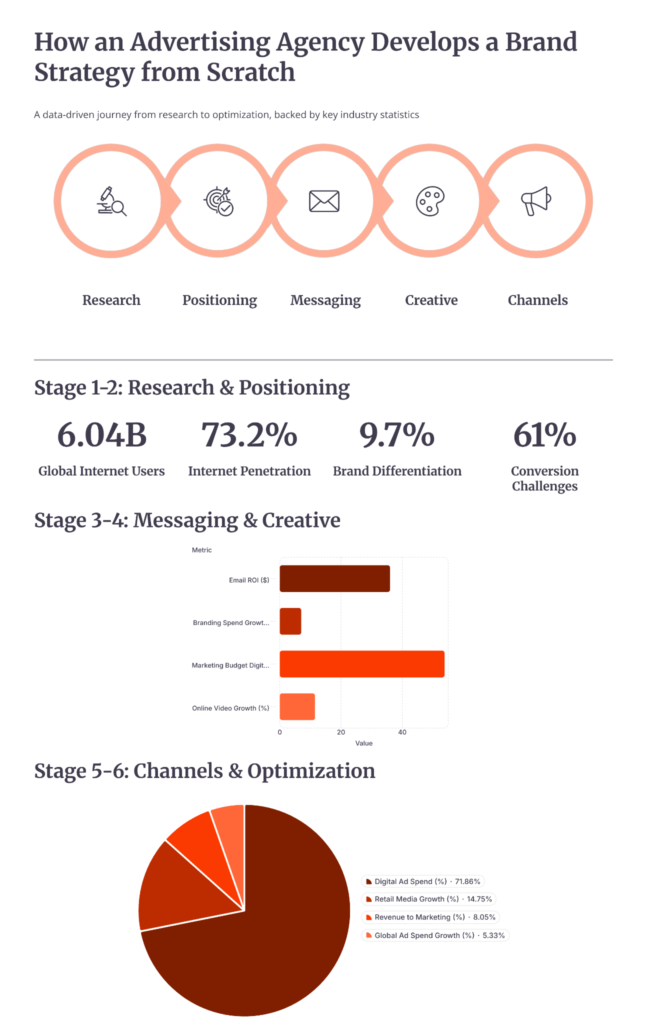
The Data-Driven Journey to Brand Success
(Visual: A circular flow diagram illustrating the key stages of brand strategy development: Research & Insights → Brand Positioning → Messaging & Storytelling → Creative Development → Channel Strategy → Measurement & Optimization)
- Stage 1: Research & Insights
- 6.04 billion global internet users by Oct 2025, providing vast data for market analysis. (Source: Brand Vision)
- 73.2% global internet penetration by Oct 2025, highlighting the reach of digital insights. (Source: Brand Vision)
- Stage 2: Brand Positioning
- 9.7% of marketers measure “brand differentiation, customer willingness to pay premium” (up 111% since 2021), underscoring the strategic importance of unique positioning. (Source: CMO Survey 2023)
- 61% of companies face dropping conversion rates, emphasizing the need for clear, differentiated positioning. (Source: Arounda Agency)
- Stage 3: Messaging & Storytelling
- $36 average email ROI per $1 spent, demonstrating the power of effective, targeted messaging. (Source: Brand Vision)
- 7.0% projected growth in branding spend over the next 12 months, indicating investment in brand narrative. (Source: The CMO Survey 2024)
- Stage 4: Creative Development
- 53.8% of marketing budgets are spent on digital marketing, requiring creative assets optimized for digital channels. (Source: CMO Survey 2023)
- 11.5% forecast online video growth in 2026, a key medium for creative brand storytelling. (Source: Brand Vision)
- Stage 5: Channel Strategy
- 68.7% of total ad spend expected to be digital in 2026, with 80%+ programmatic share of digital investment. (Source: Brand Vision)
- 14.1% forecast retail media growth in 2026, a critical channel for consumer brands. (Source: Brand Vision)
- Stage 6: Measurement & Optimization
- 7.7% of company revenue allocated to marketing budgets in 2025, necessitating clear ROI demonstration. (Source: Brand Vision)
- 5.1% projected global ad spend growth in 2026, requiring data-driven optimization for efficiency. (Source: Brand Vision)
Sources: Brand Vision (2026), Arounda Agency (2026), The CMO Survey (2023, 2024, 2025)
FAQs
1. How long does it take to develop a brand strategy?
Brand strategy development typically takes several weeks to months depending on business size, research depth, and market complexity.
2. Can small businesses benefit from professional brand strategy?
Yes. Small businesses gain clarity, competitive positioning, and consistent messaging that accelerates growth.
3. Is brand strategy only about visual identity?
No. Visual identity is one component. Strategy also includes positioning, messaging, audience targeting, and communication frameworks.
4. How often should brand strategy be updated?
Strategies should be reviewed annually or when significant market, audience, or business changes occur.
5. What is the biggest advantage of hiring an advertising agency?
An agency provides structured planning, professional research, creative expertise, and data-driven execution that reduces costly mistakes.