Google’s AI Search Update 2026: A Tutorial for North London Business Owners
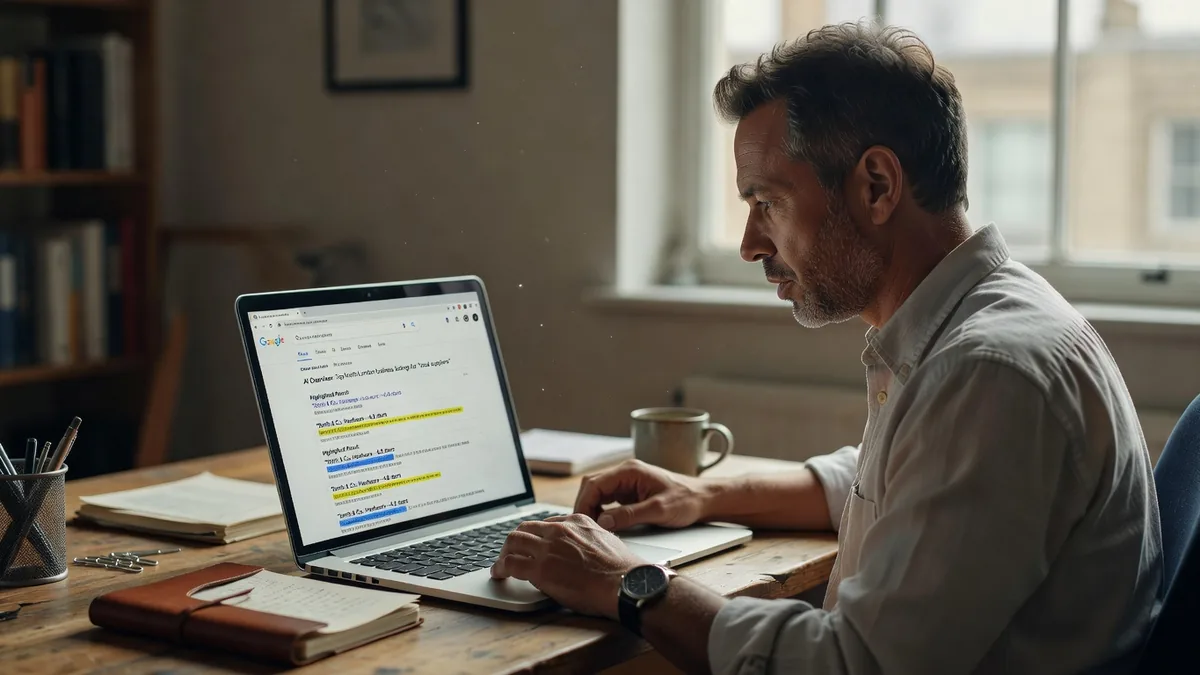
At Google I/O 2026, Google announced the biggest changes to search in 25 years. AI Mode is now reaching over 1 billion users globally. For North London business owners, this shift is no longer theoretical. It is happening now, and your customers are already using it.
This tutorial walks you through exactly what has changed, why it matters to your local business, and what you should do this week to stay visible.
Step 1: Understand What Google’s New AI Search Box Does
Google’s intelligent search box is designed to handle longer, more conversational queries. Instead of typing “dog grooming near me,” customers can now ask “What’s the best dog groomer in North London that offers eco-friendly shampoo and opens on Sundays?”
The new search experience uses Gemini 3.5 Flash, Google’s fastest AI model. This means Google is answering questions directly, often without the user needing to visit a website at all.
Why this matters: If your business information is not structured and accurate across Google Business Profile, your website, and schema markup, you will not appear in these longer, intent-rich queries.
Action this week: Check your Google Business Profile listing. Make sure your hours, phone number, categories, and service descriptions are complete and current. Even small gaps here cost you visibility.
Step 2: Learn About Google Search Agents and Agentic Experiences
Google is rolling out “agents”—AI systems that continuously scan the web for updated information on your behalf. Instead of static search results, Google will proactively update answers as new information becomes available.
For example, if you search for “best plumber in Finchley,” the agent will check multiple plumbing businesses’ websites, reviews, and availability in real time, then surface the most relevant one to your exact needs at that exact moment.
Why this matters: Your website needs to be readable and crawlable by AI agents. Your business information needs to be accurate, consistent, and updated frequently. Outdated content, broken links, or conflicting information across pages will hurt your visibility.
Action this week: Audit your website for consistency. Does your contact information match across your homepage, About page, and service pages? Are your opening hours and services clearly stated? Are there broken links? These details directly affect whether AI agents flag your business as trustworthy.
Step 3: Understand Google’s Shopping Agent and Universal Cart
Google is expanding agentic commerce. The Shopping Graph now covers 60 billion products. If you sell products (ecommerce, handmade goods, physical products), Google’s Universal Cart means customers can add items from your website directly to a cart within Google Search, without visiting your site until checkout.
Why this matters: You need structured product data (via Google Merchant Center feeds and schema markup). Without proper product feeds, your items will not show up in agentic shopping queries.
Action this week: If you sell anything online, log into Google Merchant Center and verify your product feed is live and error-free. If you do not have a feed, contact your web designer to set one up. This is no longer optional for ecommerce businesses.
Step 4: Know What “Ask Advisor” Does for Your Business Decisions
Google is launching Ask Advisor across Google Ads, Google Analytics, and Merchant Center. This is Gemini-powered AI that helps you understand your campaign performance and suggests optimizations automatically.
For example, Ask Advisor can tell you “Your conversion rate dropped 12% on Tuesdays. Pause your low-performing keywords and increase bid on mobile.” You ask questions in natural language. Gemini answers with data-driven suggestions.
Why this matters: Your marketing data is now being analysed by AI. If your Google Ads campaigns are poorly structured or your Analytics is not tracking correctly, you will miss insights that your competitors are already acting on.
Action this week: If you run Google Ads or use Analytics, set aside 30 minutes to explore Ask Advisor (it is rolling out now). Ask it one simple question about your performance. This gets you familiar with how AI is reshaping campaign management.
Step 5: Prepare Your Website for AI Search Visibility
AI agents and search features rely on three core signals more than ever:
Clear Entity Data: Google needs to understand who you are, what you do, and where you operate. Use schema markup (Organisation, LocalBusiness, Service, Product). Schema markup in 2026 is essential for AI visibility in North London.
Consistent Information: Your business name, phone, address, and service descriptions must match everywhere: website, Google Business Profile, social media, schema markup. Mismatches confuse AI agents and damage trust.
Fresh, Accurate Content: AI agents favour content that is regularly updated. If your website has not been touched in two years, agents will deprioritise you. Update service pages, add testimonials, publish case studies, refresh your blog quarterly.
Why this matters: In the old search world, you could rank with thin content and outdated information. AI search punishes this ruthlessly. You need real depth, real updates, and real accuracy.
Action this week: Do a content audit. Which pages have not been updated in over six months? Refresh three of them. Add new customer testimonials, case study results, or service details. Even small updates signal freshness to AI agents.
Step 6: Track Your AI Search Visibility Now
Traditional ranking metrics are breaking down. Keywords matter less. Links matter less in isolation. What matters now is whether AI agents choose to cite your business when answering customer questions.
This is called “AI citations” or “AI visibility.” Unlike traditional search rankings, AI citations vary by query and context. You might appear in one AI response and not another, depending on the question and the user’s location.
Why this matters: You need new ways to measure success. Traditional SEO metrics no longer tell the full story.
Action this week: Start monitoring one high-value search query in Google’s new AI Mode. Search “best [your service] in [your area]” and note whether you appear in the AI-generated answer. Check weekly. This is your new baseline metric.
Step 7: Decide: SEO or Paid Search or Both?
Many North London business owners are asking: “Should I focus on SEO or Google Ads in this new AI world?”
The answer: Both, but differently. Do not waste money on AI search yet if your fundamentals are weak. Start with organic SEO (local optimisation, content, schema markup). Once that is working, layer in paid ads to accelerate growth.
Why this matters: AI search favours organic authority. Paid visibility is still valuable, but only if your organic foundation is solid.
Action this week: Book a free SEO audit. Understand where your business currently stands in traditional search. Then plan your AI search strategy from that baseline.
What Happens Next
Google will continue rolling out AI search features through 2026. Ranking volatility around major updates is normal. What is not normal is standing still.
The businesses that win in AI search are the ones that:
- Keep their business information accurate and consistent everywhere
- Update their website with fresh content every month
- Use schema markup to clarify who they are and what they offer
- Monitor AI citations, not just traditional rankings
- Stay curious and experiment with new features as Google releases them
You do not need to be a technical expert. You do not need to overhaul your entire marketing strategy. You just need to stay informed, stay fresh, and stay visible.
If you are a North London business owner and you want help navigating these changes, get in touch with our team. We can audit your AI search visibility, update your website, and prepare your business for what comes next. Our SEO services are designed specifically for local businesses facing these shifts.
Frequently Asked Questions
What is the difference between traditional Google search and AI Mode?
Traditional search shows a list of websites ranked by relevance. AI Mode generates a direct answer using information from multiple sources, then shows those sources below. AI Mode reaches longer, more conversational queries and prioritises accuracy over keyword matching.
Will AI search kill my website traffic?
Not if you optimise for AI visibility. You may see fewer clickthroughs from traditional search results, but more direct inquiries from customers who found you in AI-generated answers. The total opportunity is larger, not smaller.
Do I need to change my website design for AI search?
No. You need to ensure your website is technically sound (fast, mobile-friendly, crawlable), your content is accurate and up to date, and your business data is structured with schema markup. Design stays the same. Substance matters more.
How long before AI search affects my business?
It already is. AI Mode reached 1 billion users this month. Your customers are using it now. You have this week to start preparing.
What is the most important thing I can do right now?
Update your Google Business Profile. Make sure every detail is correct: name, phone, address, hours, categories, description. This single action improves your visibility in both traditional and AI search immediately.