Which On-Page Elements Matter Most in Local SEO for Multiple Locations?

Local search has evolved rapidly in recent years. Businesses that operate across several cities or regions now face a unique challenge: maintaining consistent visibility in each location while still presenting a unified brand presence. This is where Local SEO for Multiple Locations finchely becomes particularly important.
When search engines evaluate a website with several physical locations, they rely heavily on on-page signals. These signals help determine whether a page is relevant for users searching in a specific geographic area. From structured location pages to accurate contact information, every detail on the page contributes to how search engines interpret local relevance.
Organizations such as SEO and Digital Marketing Agency Finchley often examine these elements closely because even minor adjustments can influence local search visibility. Understanding which on-page components matter most allows businesses to build stronger geographic authority and improve their ability to appear in local search results.
Understanding the Concept of Multi-Location Local SEO

Local SEO typically focuses on improving visibility for businesses within a specific geographic area. However, when a business operates in several cities, neighborhoods, or service regions, the strategy becomes more complex.
Instead of optimizing a single website page for one area, companies must ensure each location has a clear digital presence that search engines can understand.
Why Multi-Location Businesses Need a Unique SEO Strategy
A single page cannot effectively represent multiple geographic areas. Search engines aim to deliver results that match a user’s location as closely as possible. If a website lacks clear location-specific signals, it may struggle to appear in relevant searches.
For example, someone searching for services in Finchley expects results specifically related to that area. If a business operates in multiple locations but only highlights one, the search engine might overlook other regions.
The Growing Importance of Location-Specific Search
Local search intent continues to increase, particularly with mobile devices. People frequently search for services nearby, expecting immediate and geographically relevant results.
This behavior makes localized page content and structured on-page signals more important than ever.
What Makes On-Page SEO Different for Multiple Locations
Traditional on-page SEO focuses on content relevance, keyword usage, and user experience. In multi-location scenarios, geographic relevance becomes an additional layer.
Local Search Intent and Geographic Signals
Search engines analyze contextual signals such as city names, addresses, landmarks, and service areas. These signals help determine whether a page matches a user’s search location.
Search Engine Interpretation of Location Relevance
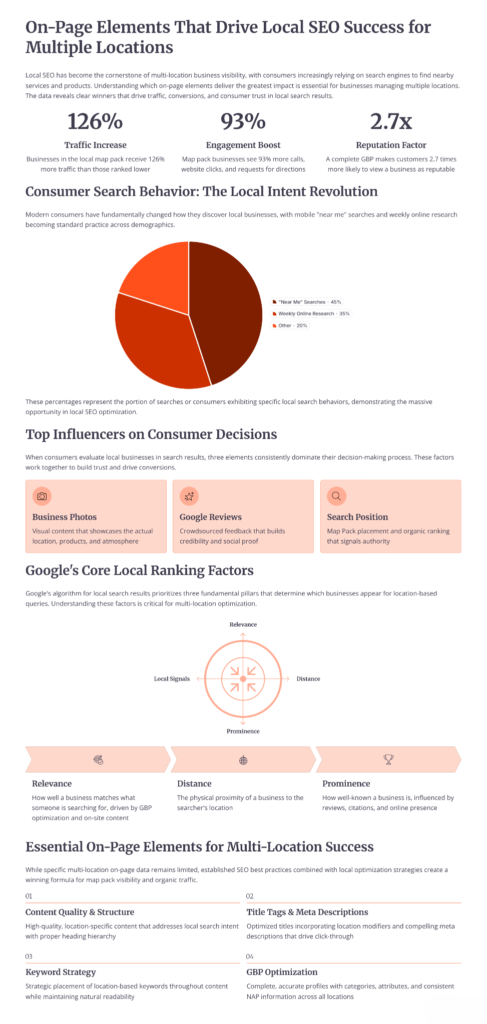
Algorithms attempt to match three primary factors:
- Relevance
- Distance
- Prominence
On-page elements strongly influence the relevance factor. When a page clearly identifies its location, it becomes easier for search engines to associate it with local searches.
Optimized Location Pages as the Foundation
Dedicated location pages are arguably the most important element of Local SEO for Multiple Locations in finchely.
Structuring Dedicated Location Pages
Each physical location should ideally have its own page with unique content. These pages should include:
- Location-specific headings
- Detailed service descriptions
- Local references
- Contact information
Essential Content Components for Each Page
Unique descriptions
Each location page should explain services in the context of that specific area.
Local landmarks
Mentioning recognizable places nearby can strengthen geographic relevance.
Service coverage
Clear explanations of service areas help search engines understand geographic scope.
Title Tags and Meta Descriptions for Local Relevance
Title tags remain one of the strongest on-page ranking signals.
Geographic Keyword Integration
Including location names naturally within title tags helps search engines associate the page with local queries.
For example:
Service Type + Location + Brand
Avoiding Duplicate Metadata
Multi-location websites often repeat the same metadata across pages. This practice can confuse search engines.
Each page should contain unique metadata reflecting its geographic focus.
Localized Content and Contextual Signals
Search engines favor content that demonstrates real local relevance.
Creating Hyper-Local Content
Hyper-local content might include:
- Neighborhood insights
- Local events
- Regional challenges
- Community trends
These elements make content more authentic and locally meaningful.
Addressing Community-Specific Needs
Different areas may have different customer needs. Addressing these variations through tailored content helps search engines understand regional relevance.
NAP Consistency and Contact Information
NAP stands for Name, Address, and Phone number.
Importance of Accurate Business Details
Search engines rely on consistent business information across the web. Any inconsistency can reduce trust signals.
Formatting NAP for Search Engines
Clear formatting improves readability and crawlability. Contact details should appear prominently on location pages.
Businesses focusing on Local SEO for Multiple Locations finchely often ensure that each location page displays accurate NAP details aligned with external listings.
Internal Linking Strategy for Multi-Location Sites
Internal linking helps distribute authority across a website.
Connecting Location Pages
Location pages should link logically to:
- Parent service pages
- Nearby locations
- Regional service areas
This creates a structured navigation path.
Supporting Local Relevance Through Anchor Text
Anchor text can reinforce geographic signals by referencing the location naturally.
Schema Markup for Local Businesses
Structured data helps search engines interpret page information more effectively.
Structured Data and Search Visibility
Schema markup provides context about business details, including addresses, opening hours, and services.
Key Schema Types for Multi-Location SEO
Common schema types include:
- LocalBusiness
- Organization
- PostalAddress
When implemented correctly, structured data enhances search engine understanding of location information.
Optimizing Images and Media for Local Signals
Images can also contribute to local relevance.
Geo-Relevant Image Metadata
Optimized image elements include:
- File names
- Alt text
- Captions
These attributes can reference the location naturally.
Visual Context for Local Trust
Images of physical storefronts, nearby landmarks, or interior spaces help reinforce authenticity.
Mobile Optimization and User Experience
Most local searches occur on mobile devices.
Local Search Behavior on Mobile
Mobile users often search while traveling, shopping, or exploring nearby services. They expect fast and easy access to relevant information.
UX Elements That Influence Rankings
User experience signals may include:
- Click behavior
- Time on page
- Interaction with contact details
Clear navigation and readable content improve engagement.
Page Speed and Technical Performance
Technical factors also influence local visibility.
Speed as a Local Ranking Factor
Fast loading pages reduce bounce rates and improve user satisfaction.
Technical Improvements That Support SEO
Key performance improvements include:
- Image compression
- Efficient code
- Server optimization
These technical factors ensure pages remain accessible across devices.
Local Reviews and Social Proof Integration
Customer reviews play a meaningful role in local search perception.
Displaying Reviews on Location Pages
Embedding genuine feedback helps demonstrate credibility.
Encouraging Authentic Feedback
Search engines value authenticity. Reviews reflecting real customer experiences provide stronger trust signals.
Organizations such as SEO and Digital Marketing Agency Finchley frequently analyze review patterns because they contribute to overall local authority.
Content Freshness and Local Updates
Search engines prefer websites that remain active and updated.
Updating Location-Specific Information
Businesses should regularly review:
- Opening hours
- Contact details
- Service descriptions
Events and Community Engagement
Highlighting local events or partnerships helps reinforce community presence.
Measuring the Effectiveness of On-Page Local SEO
Optimization efforts must be evaluated regularly.
Tracking Local Rankings and Engagement
Metrics may include:
- Location-specific keyword rankings
- Organic traffic by region
- User interaction signals
Continuous Optimization Strategies
Local search landscapes change frequently. Updating content and refining location signals ensures continued relevance. Its all possible with the Best Social Media Marketing Agency
SEO and Digital Marketing Agency Finchley Serving the Finchley Community and Beyond in Finchley
SEO and Digital Marketing Agency Finchley is dedicated to serving the diverse needs of the local community of Finchley, including individuals residing in neighborhood like Finchley. With its convenient location near landmarks such as the St. Margaret’s United Reformed Church and major intersections like Church cres and Dollis Park (coordinates: 51.602114, -0.1968246), we offer Local SEO for Multiple Locations services.
Get Local SEO for Multiple Locations Services at Finchley Central Now
Call Us or Contact Us: +4420 33558773
Navigate from Finchley to SEO and Digital Marketing Agency Finchley Now
Optimizing on-page elements for multi-location businesses requires a careful balance between consistency and localization. Search engines rely on numerous signals from title tags and structured data to localized content and accurate contact information to determine geographic relevance.
A strong strategy for Local SEO for Multiple Locations finchely focuses on clear location pages, unique metadata, consistent NAP information, and meaningful local content. When these elements work together, they help search engines confidently match a business with users searching in specific areas.
Businesses studying these factors such as insights often explored by SEO and Digital Marketing Agency Finchley can better understand how search engines interpret local relevance and improve visibility across multiple geographic markets.
Dominating Local Search: Key On-Page Elements for Multi-Location Success
The Local Search Landscape: A Numbers Game
- 8 out of 10 US consumers search for local businesses online at least once a week. (SOCi)
- 46% of Google searches have local intent, underscoring the critical need for localized optimization. (Rankmax)
- Businesses in the Google Map Pack receive 126% more traffic and 93% more calls, clicks, and direction requests than those ranked lower. (Semrush)
Crucial On-Page Elements for Multi-Location Businesses
1. Google Business Profile (GBP) Optimization: The Foundation
- A complete GBP makes customers 2.7 times more likely to view a business as reputable. (Google)
- Customers are 70% more likely to visit and 50% more likely to consider purchasing from businesses with a complete GBP. (Google)
- GBP signals are the primary driver of Google 3-Pack rankings (32%), followed by on-page SEO (19%) and review signals (16%). (BrightLocal)
2. On-Page Relevance: Speaking the Local Language
- Relevance is a core Google ranking factor, achieved through precise GBP categories, service lists, and on-page content that mirrors customer needs. (Searcle AI)
- Dedicated location and service pages are vital for signaling geographic relevance and topical authority. (Searcle AI)
- NAP (Name, Address, Phone Number) consistency across GBP and website is paramount for trust and local ranking. (Searcle AI)
3. User Experience & Page Speed: Keeping Them Engaged
- Optimizing Core Web Vitals can increase mobile revenue by up to 42%. (MKDM)
- Mobile optimization and responsive design are essential, as 57% of local searches are performed on mobile devices. (Semrush)
- User experience and engagement signals are key on-page factors for ranking higher in 2026. (Wellows)
4. Visual Assets & Content Quality: Building Trust and Authority
- Visual assets and media support are important on-page SEO factors. (Wellows)
- Content quality and search intent alignment are critical for ranking higher. (Wellows)
- 47% of shoppers will go to another nearby business if their intended store is unexpectedly closed, highlighting the need for accurate and engaging information. (SOCi)
The Impact: Driving Visibility and Conversions
- 76% of consumers who search “near me” visit a business within a day. (Rankmax)
- 80% of local searches result in conversions. (Rankmax)
- 42% of people who conduct a local search click straight into the results shown in the Google Map Pack. (AIOSEO via FeedTheBot)
Key Takeaway: Prioritize Local Signals
Focusing on a complete Google Business Profile, highly relevant location-specific content, seamless user experience, and high-quality visuals will significantly boost your multi-location business’s visibility and drive more local customers through your doors.
FAQs
1. Why are dedicated location pages important for multi-location SEO?
Dedicated pages allow search engines to clearly associate each location with relevant geographic searches, improving the chances of appearing in local results.
2. How does NAP consistency affect local rankings?
Consistent business information across webpages and listings strengthens trust signals for search engines and reduces confusion about business details.
3. What role does schema markup play in local SEO?
Schema markup provides structured information that helps search engines interpret location details such as addresses, services, and operating hours.
4. Can duplicate content harm multi-location websites?
Yes. Repeating identical content across location pages can dilute relevance and make it harder for search engines to differentiate between locations.
5. How often should location pages be updated?
Regular updates are recommended, especially when business details, services, or local information change. Fresh content signals that the page remains relevant and accurate.