What Does an Advertising Agency Do?


An advertising agency exists to do one fundamental thing: connect businesses with the right audience in the most effective way possible. But that simple sentence barely scratches the surface.
If you’ve ever wondered what really happens behind a campaign—how brands appear consistently across search engines, social media feeds, billboards, and websites—this is where an agency steps in. It’s not just about designing an ad. It’s about strategy, psychology, data, media placement, and measurable outcomes.
Let’s break it down properly.
Understanding the Core Role of an Advertising Agency
At its core, an advertising agency plans, creates, executes, and optimizes marketing campaigns for businesses. Think of it as the command center behind brand communication.
An agency studies the market, identifies opportunities, develops messaging, chooses channels, launches campaigns, and then measures results. It handles both the creative and analytical sides of advertising.
The Strategic Foundation Behind Every Campaign
Before a single ad is written or designed, strategy comes first. Agencies analyze:
- Market conditions
- Competitor positioning
- Audience demographics
- Industry trends
Without strategy, advertising becomes guesswork. With strategy, it becomes precision.
Bridging Brands and Audiences
An agency acts as a translator. Businesses understand their products. Consumers understand their problems. The agency bridges the gap by turning features into meaningful benefits that resonate with the audience.
Market Research and Consumer Insights
You can’t advertise effectively if you don’t know who you’re talking to.
Audience Profiling and Behavioral Analysis
Agencies build detailed customer profiles. They examine:
- Age, income, location
- Online behavior
- Buying triggers
- Pain points
This allows campaigns to be highly targeted rather than broad and inefficient.
Data Collection Methods
Data may come from surveys, website analytics, CRM systems, keyword research, and social media insights. Modern advertising is deeply data-driven.
Turning Data into Strategy
Raw data is meaningless without interpretation. Agencies transform numbers into actionable insights. If analytics show a high drop-off rate on a landing page, the agency identifies why and adjusts messaging or design.
Brand Strategy Development

Strong advertising is impossible without a clear brand identity.
Defining Brand Positioning
Positioning answers a key question: Why should someone choose this business over competitors?
Agencies identify a brand’s unique value proposition and build campaigns around that differentiation.
Crafting Brand Messaging Frameworks
Messaging must remain consistent across all channels. Agencies create tone guidelines, value statements, taglines, and content pillars that ensure every communication reinforces the same identity.
Creative Concept Development
Creativity is where strategy becomes visible.
Copywriting and Visual Design
Advertising agencies develop:
- Ad copy
- Headlines
- Video scripts
- Display graphics
- Landing page content
Every word and visual serves a strategic purpose. Good creative doesn’t just look attractive—it persuades.
Campaign Theme Creation
Campaigns often revolve around a central theme or narrative. This creates coherence across platforms. A single campaign idea may translate into multiple ad formats while maintaining one consistent message.
Media Planning and Media Buying
Creating an ad is only half the equation. The next question is: where should it appear?
Selecting the Right Channels
Agencies determine whether campaigns should run on:
- Search engines
- Social media platforms
- Display networks
- Video platforms
- Traditional media
The choice depends on audience behavior and campaign objectives.
Budget Allocation and Optimization
An effective agency carefully distributes budget across channels. It monitors performance in real time and reallocates spending toward the highest-performing platforms.
Digital Advertising and Performance Marketing
Modern agencies focus heavily on measurable digital channels.
Search Engine Advertising
Paid search campaigns target users actively searching for products or services. This intent-driven approach often produces high conversion rates.
Social Media Advertising
Social platforms allow granular targeting based on interests, behaviors, and demographics. Agencies design campaigns tailored to specific audience segments.
Display and Retargeting Campaigns
Retargeting ensures that users who previously visited a website are reminded of the brand through strategic ad placements across other websites.
Content Marketing and Campaign Support
Advertising doesn’t operate in isolation. It works best when supported by valuable content.
Educational Content Strategies
Agencies develop blog posts, guides, and informative resources that build authority and trust.
SEO Integration
Search engine optimization strengthens long-term visibility. For example, an advertising agency finchely operating in a competitive local market must optimize content to rank for relevant geographic keywords. Organic visibility supports paid advertising efforts and reduces long-term dependency on ad spend.
Analytics, Reporting, and Campaign Optimization
Advertising without measurement is incomplete.
Key Performance Indicators (KPIs)
Agencies track:
- Click-through rates
- Conversion rates
- Cost per acquisition
- Return on ad spend
- Engagement metrics
KPIs align directly with campaign objectives.
A/B Testing and Continuous Improvement
Testing is constant. Agencies compare ad variations, headlines, visuals, and calls to action. Small changes can significantly impact performance. Optimization is ongoing, not a one-time action.
Local Advertising Strategy and Geographic Targeting
Location matters more than most businesses realize in advertising locally.
Why Location-Based Strategy Matters
Local campaigns require understanding community demographics, search patterns, and competitive density. Messaging often differs between national and local audiences.
Advertising Agency Finchely: Local Market Understanding
An advertising agency in finchely must account for local consumer behavior, regional search intent, and market competition. Localized keyword strategies, geo-targeted campaigns, and community-specific messaging increase relevance and engagement.
Collaboration with Businesses and Internal Teams
Agencies don’t operate in isolation.
Workflow and Communication Structure
Typically, an agency assigns account managers who coordinate between creative teams, analysts, and the client. Clear reporting structures ensure transparency.
Aligning Marketing with Business Goals
Advertising must reflect business objectives. Whether the goal is lead generation, brand awareness, or product launches, strategy aligns with measurable outcomes.
How Agencies Evolve with Market Trends
Advertising changes constantly.
Technology and Automation
Automation tools optimize bidding strategies, segment audiences, and analyze performance faster than manual processes ever could.
Data-Driven Decision Making
Today’s agencies rely heavily on analytics platforms. Decisions are increasingly evidence-based rather than intuitive.
The Role of SEO and Digital Marketing Agency Finchley in Integrated Campaigns
Integrated marketing means combining multiple channels into one cohesive strategy.
Combining SEO with Paid Advertising
When SEO and paid search work together, visibility increases across both organic and sponsored listings. This dual presence builds authority and improves click-through rates.
SEO and Digital Marketing Agency Finchley demonstrates how integrated campaigns strengthen long-term growth while maintaining short-term performance gains.
Long-Term Growth Planning
Advertising is not just about immediate results. Sustainable strategies build brand equity over time. Agencies analyze lifetime customer value and design campaigns that support long-term expansion.
SEO and Digital Marketing Agency Finchley Serving the Church End Community and Beyond in Finchley
SEO and Digital Marketing Agency Finchley is dedicated to serving the diverse needs of the local community of Finchley, including individuals residing in neighborhood like Church End. With its convenient location near landmarks such as the St Paul’s, Finchley and major intersections like Falkland Ave and Ballards Ln (coordinates: 51.604364, -0.1895796), we offer advertising agency services.
Get advertising agency Services at Church End Now
Call Us or Contact Us: +4420 33558773
Navigate from Church End to SEO and Digital Marketing Agency Finchley Now
So, what does an advertising agency do?
It researches markets.
It defines strategy.
It crafts messaging.
It produces creative assets.
It selects channels.
It manages budgets.
It analyzes performance.
It optimizes continuously.
An advertising agency is both architect and engineer. It designs the blueprint and ensures every component works together. Whether operating nationally or as an advertising agency finchely serving a local market, the objective remains the same: create structured, measurable, and strategic communication that drives business growth.
Advertising isn’t guesswork. Done properly, it’s a system.
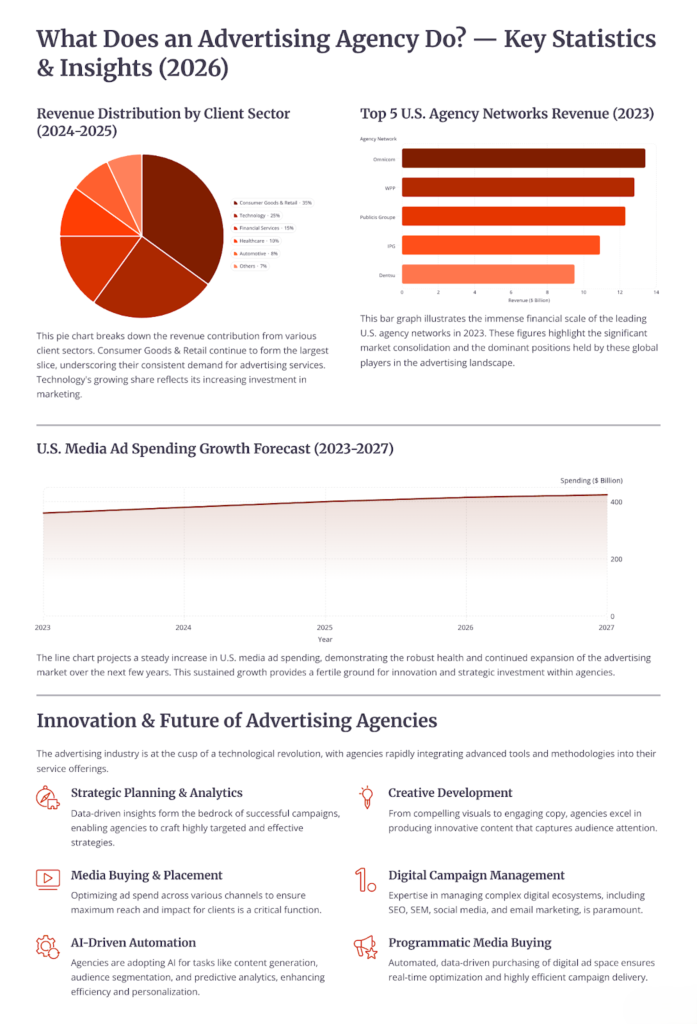
What Does an Advertising Agency Do? — Key Statistics & Insights (2026)
- Revenue by Client Sector (2024-2025):
- Consumer Goods & Retail dominate agency revenues, followed by Technology and Financial Services.
- Top 5 U.S. agency networks (Omnicom, IPG, WPP, Publicis) generated combined revenues exceeding $30 billion in 2023.
- New business revenue is increasingly competitive; Publicis led with $700M in new business in 2023.
- Industry Financial Scale:
- U.S. media ad spending forecast to surpass $380 billion in 2024, growing to $424 billion by 2027.
- Digital advertising agencies alone earned $44.8 billion in 2023, a fivefold increase over the past decade.
- Employment Trends:
- U.S. advertising and PR employment declined monthly from late 2024 through mid-2025, signaling structural shifts and economic caution.
- Agencies are adapting by investing heavily in AI and automation to boost efficiency and creativity.
- Agency Services & Innovation:
- Core functions: strategic planning, creative development, media buying, digital campaign management, and analytics.
- Growing focus on AI-driven automation, programmatic media buying, cross-device targeting, and omnichannel activation.
- Major agencies plan multi-hundred-million-dollar investments in generative AI technologies in 2024-2026.
Visuals for Slide:
- Pie chart: Revenue distribution by client sector (Consumer Goods, Tech, Financial, Others)
- Bar graph: Top 5 agency network revenues (2023)
- Line chart: U.S. media ad spending growth forecast (2023-2027)
- Infographic icons: Agency core services + AI investment highlights
Sources: Ad Age Agency Report 2024-2025, Statista 2026, Basis 2025 Advertising Agency Report, eMarketer 2024
FAQs
1. What is the primary function of an advertising agency?
The primary function is to plan, create, execute, and optimize marketing campaigns that connect businesses with their target audience.
2. How does an advertising agency measure campaign success?
Agencies measure success through key performance indicators such as conversions, return on ad spend, engagement rates, and lead quality.
3. Do advertising agencies handle both digital and traditional media?
Yes, many agencies manage both digital platforms and traditional media channels, depending on client strategy and objectives.
4. Why is local expertise important for an advertising agency finchely?
Local expertise ensures campaigns reflect regional consumer behavior, competition, and search trends, improving targeting accuracy.
5. How does SEO integrate with advertising campaigns?
SEO strengthens organic visibility, supports paid campaigns, and improves overall digital presence, creating a more comprehensive marketing strategy.